








Ki-demang.com : Candi

Kaca Ngajeng Candhi

ikon-kaca-ngajeng
 

ikon-buku-tamu

candi-prov-yogyakarta

candi-sleman
candi-bantul
candi-gunung-kidul
candi-kulon-progocandi-kota-yogyakarta


 candi-prov-jawa-tengah
candi-klaten
candi-magelang
candi-boyolali
candi-temanggung
candi-kabupaten-semarang
candi-banyumas
candi-wonosobo
candi-kota-semarang
candi-kendal
candi-banjarnegara
candi-batang
candi-pemalang
candi-tegal
candi-brebes
candi-purwodadi
candi-kudus
candi-purworejo
 candi-purbalingga
candi-kebumen

    Jumlah Pengunjung

0463454
  Hari ini     :  Hari ini :117
  Kemarin     :  Kemarin :141
  Minggu ini   :  Minggu ini :253
  Bulan ini   :  Bulan ini :2870
  s/d hari ini   :  s/d hari ini :463454
Pengunjung Online : 11

Kontak Admin.

email-kidemang

05a Candi Barong

candi-barong-wikipedia

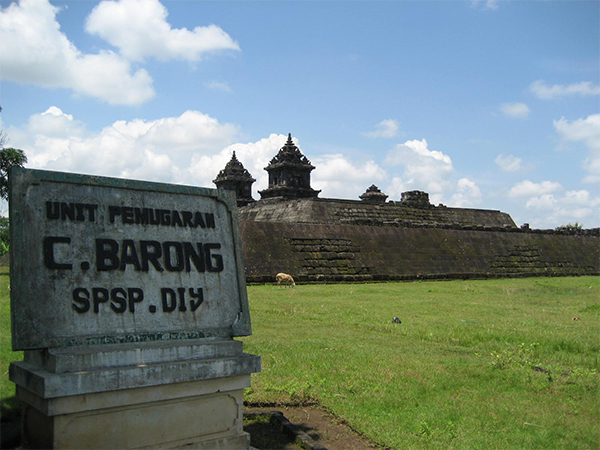
http://upload.wikimedia.org/wikipedia/commons/thumb/6/6d/Candi_Barong.JPG/800px-Candi_Barong.JPG


Candi Barong adalah candi Hindu yang terletak di dekat Kompleks Ratu Boko.


Letak

Candi Barong terletak di atas bukit di dusun Candisari, kelurahan Bokoharjo, Prambanan, Kabupaten Sleman, Yogyakarta. Candi ini dibangun pada sekitar abad ke-9 dan ke-10 pada zaman Kerajaan Mataram Kuno.


Arsitektur

Candi ini mendapatkan nama 'barong' karena memiliki hiasan kala dan makara pada setiap relung seperti umumnya candi di Jawa, yang mirip dengan barong. Kompleks candi ini berada di atas tanah berundak 3 dengan beberapa bangunan candi pada setiap terasnya. Pada teras tertinggi terdapat dua buah candi untuk pemujaan Dewa Wisnu dan Dewi Sri. Masing-masing candi ini mempunyai ukuran kira-kira 8 meter x 8 meter dengan tinggi 9 meter.


Keistimewaan

Salah satu keistimewaan bangunan candi utama ini adalah tidak adanya pintu masuk, sehingga upacara pemujaan diperkirakan dilakukan di luar bangunan. Selain itu, pemujaan terhadap Wisnu juga merupakan keistimewaan kompleks candi ini. Umumnya, candi-candi Jawa Tengah memuja Dewa Syiwa atau bersifat Syiwaistis.


Sumber : http://id.wikipedia.org/wiki/Candi_Barong


BARONG (Sari, Sari Sorogeduk, Sari Sorogedug)


Administrative localization:

Candisari, Sambirejo, Prambanan, Sleman, DIY.


Geographical localization:

07° 46' 32.3" S
110° 29' 49.9" E
Precision: 24m
Alt.: 200m


Surroundings:

In lower middle land, atop a hill belonging to the Gunung Kidul massif, a hundred meters from the spring of the kali Gawe/Sorogeduk. From the path leading to the temple and from the sanctuary itself, the view is breathtaking. To the north, the summit of Mount Merapi raises above the hills. To the south and southeast, one can see the crescent formed by the range of Gunung Kidul. To the southwest gunung Abang is clearly visible. To the west, the landscape opens completely and one can see as far as the Menoreh hills. Banyunibo, Dawangsari and the pendopo of Ratu Boko can all be seen from the temple area.145 The site is located 100m to the south of Dawangsari, 450m to the northeast of candi Banyunibo, 550m to the south of Arca Ganeca, 600m to the south southeast of Sumberwatu, 800m to the southeast of the pendopo of Ratu Boko and 1000m to the north of Tinjon.


Religion: Hindu (Vaishnava ?).
Main features: Sanctuary type 5; organic compound; facing west; square; enclosure walls.


State of preservation: The twin temples have been restored up to the superstructure, but out of the buildings of the lower courtyard only foundations remain.


Description:

The upper part of the hill has been re-shaped into a terrace; it opens to the west, is reached via a single stair and measures 90m (E-W) x 63m (N-S). On the terrace raises an enclosure wall divided into two courtyards. Although the exact height of this wall is unknown, given its thinness, it should not have been very high.146 The only access to the courtyard is the gopura pierced in the western wall.147
The western courtyard measures roughly 41m (E-W) x 46m (N-S) and is occupied by foundations of various buildings. Their organization is not symmetrical and does not seem to follow any logical pattern.
The southwest quarter of the courtyard shelters remains of a pendopo, measuring 10,60 (E-W) x 11,70m (N-S). This large building had a rectangular plan and was composed of a main room and a front room.148 The main room was supported by 10 columns (3 on the northern and southern sides, 4 on the eastern and western sides). Only two columns remain in the front room.
The northwest, northeast and southeast areas of this first courtyard are also occupied by one platform each. These platforms are smaller than the one described above.
Right in front of the gopura a paved path leads to another foundation, situated at the rear of the courtyard and on its east-west axis. Its localization gives the impression that it was necessary to go through the building (maybe a kind of open pavilion or simply a terrace for offerings) to have access to the second courtyard.
In the southwestern part of the first courtyard, stand the remains of four small buildings or altars.
A second gopura leads from the western courtyard to the eastern – and rear – courtyard. Its inner space is almost entirely occupied by a huge terrace measuring 22m (E-W) x 36m (N-S) at the top. This rectangular terrace is asymmetrical: it is longer south of the gopura than north of it. Actually this was not originally the case; traces of enlargement are still visible in its southern part.149 The terrace is bordered by an enclosure wall with a single gopura (to the west). On the northern, eastern and southern sides of the enclosure, instead of a gopura, one finds a false door. Symbolically, the sanctuary is thus opened towards the four directions.
Within the courtyard, stand two small monuments. Their bases are unusually high and the temples have neither stairs nor doors.
They are 269º29' from the north (Siswoyo, 1996: 7).
The northern structure is commonly known as candi I while the south one is candi II. Both are square and built upon a three-storied podium (8.40m x 8.40m). The base measures 5m x 5m while the temple body is 3.70m x 3.70m. The latter has four niches, one on each side.
Although there is no entrance, both temples do possess an inner space: a pit is going through both the base and temple body (Santoso 1992: 23).
During the excavation, a layer of river stones was found under the base of candi I. Under this layer was discovered a sort of huge peripih. It measured 3x3m and was made out of 9 cavities directly dug in the ground. The central cavity measured 1.5x1.5m, while the 8 holes at its periphery were 1m square. In the southeastern square a stone box was discovered (Santoso 1992: 23).
Under candi II there was only one huge cavity, directly dug from the earth. It measured 3x3m. Parts of an earlier stone structure were found beneath the present-day candi II (Santoso 1992: 24).


Sculptures:
Several sculptures were found here: 3 female figures and three male figures (Darmojo, Hartini, Sastra, Soenarto, Tjandrasasmita 1984-1985: 27-29; Laporan inventarisasi Wukirharjo, Sumberharjo dan Sambirejo 1994). Among the female figures, one was left unfinished. The two others represent seated women with four arms. Unfortunately, only one of these sculptures is in a satisfactory state of preservation. It was found in the southeastern corner of the central courtyard. In her raised right hand, the woman is holding a flower, while the other right hand is opened on her knee. In her raised left hand, she's holding a rice ear. Her second left hand is opened and laying on her lap. Among the male sculptures, only one has been finished. It is also seated and four-armed, although his attributes cannot be identified. His head is adorned with a high cylindrical headdress. It is highly probable that, given the rice and the cylindrical headdress, these sculptures represent Wisnu and dewi Śrī. An unfinished four-armed Ganeśa was discovered in the surroundings, probably coming from Sumberwatu (Laporan Inventarisasi Wukirharjo, Sumberharjo dan Sambirejo 1994).


Sumber : Candi Space and Landscape - Véronique Myriam Yvonne Degroot


kds penutupwangsul-manginggil

  • < 04 (b) Candi Banyunibo
  • 05b Candi Barong >