






Mdang i Bhumi Mataram

beranda

ikon-buku-tamu

kerajaan-mataram-kuno

kumpulan-makalah

kumpulan-artikel

candi-yogyakarta
prambanan
   01 Kabupaten Sleman - 77
   02 Kabupaten Bantul - 7
   03 Kabupaten Gunung Kidul - 6
   04 Kabupaten Kulon Progo - 5
   05 Kota Madya Yogyakarta - 1

candi-jawa-tengah
borobudur
   01 Kabupaten Klaten - 13
   02 Kabupaten Magelang - 79
   03 Kabupaten Boyolali - 10
   04 Kabupaten Temanggung - 23
   05 Kabupaten Semarang - 14
   06 Kabupaten Banyumas - 8
   07 Kabupaten Wonosobo - 5
   08 Kotamadya Semarang - 5
   09 Kabupaten Kendal - 7
   10 Kabupaten Banjarnegara - 6
   11 Kabupaten Batang - 4
   12 Kabupaten Pemalang - 2
   13 Kabupaten Tegal - 2
   14 Kabupaten Brebes - 2
   15 Kabupaten Purwodadi - 1
   16 Kabupaten Kudus - 1
   17 Kabupaten Purworejo - 2
   18 Kabupaten Purbalingga - 1
   19 Kabupaten Kebumen - 2

 relief-borobudur
relief-O-01
01 Relief Karmawibhangga
02-Caca-Jataka-1
02 Relief Jataka

prasasti
ikon-prasasti

video
00-mataram-kuno-1
Aneka Video Medang

jumlah-pengunjung
368233
  Hari ini     :  Hari ini :371
  Kemarin     :  Kemarin :156
  Minggu ini   :  Minggu ini :523
  Bulan ini   :  Bulan ini :4222
  s/d hari ini   :  s/d hari ini :368233
Jumlah Kunjungan Tertinggi
28.10.2025 : 1113
Pengunjung Online : 9

kontak-admin
email-kidemang

Candi Kabupaten Sleman - 77 Candi
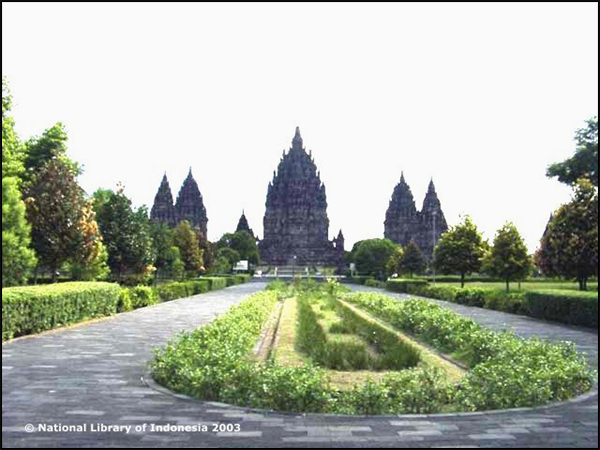
41b Prambanan /  Loro Jonggrang

PRAMBANAN OR LORO JONGGRANG
Administrative localization:

Karangasem, Bokoharjo, Prambanan, Sleman, DIY.


Geographical localization:

07° 45' 07.4"
110° 29' 29.2"
Precision: 13m
Alt.: 150m


Surroundings:

In lowland, on flat ground. Some 200m east of a branch of kali Opak. South of Sewu, Bubrah and Lumbung. From the main courtyard, view of the three above mentioned temples, as well as of Plaosan Lor, Ratu Boko, Dawangsari and Ijo. The site is located 550m to the northeast of Bogem, 500m to the south-southwest of Lumbung, 600m to the south-southwest of Bubrah, 1000m to the south-southwest of Sewu and 1100m to the northeast of Sojiwan.


Religion: Hindu.
Main features: Concentric compound organised around a sanctuary type 3; facing east; staggered square with four cella; enclosure walls; outer enclosure with a specific orientation.
State of preservation: Buildings in the central courtyard have been restored up to the superstructure. Several secondary temples within the outer enclosure have been thoroughly rebuilt too, but most of them are reduced to their bases. Of the outer enclosure, only the southern gopura is still visible.


Description:

Loro Jonggrang is a wide compound made out of three courtyards and corresponding enclosure walls.
o First courtyard
The first (or inner) courtyard measures 103m x 103m (inner measurements). Its ground level is considerably higher than the surrounding natural ground level.
It was artificially raised by building a large number of walls in river stones and by filling the gaps between these walls with earth and sand (Stutterheim 1936: fig.4).
8 buildings occupy the courtyard. In the western part of the courtyard is a row of three huge temples (known as candi Brahma, Siwa and Wisnu), the widest (candi Siwa) being at the centre. In the eastern part of the courtyard, in front of the above-mentioned buildings are three smaller shrines in a line.130 The space between the two rows of shrines is flanked to the north and south by an additional building. Further, 8 miniature temples mark the cardinal points of the courtyard.


Candi Siwa
Candi Siwa is the largest structure of the compound.
It is almost exactly orientated towards the east (88º51') (Siswoyo 1996: 6).
Its basement is staggered square measuring 27.50m. It can be reached via four staircases, one on each side131. The staircases are flanked by some kind of miniature temples, although only the one located south of the eastern staircase has an inner space.132
A balustrade tops the base. From the four gates of this balustrade large stairs climb to the temple body, while two lateral, smaller staircases gives access to an open-air circumambulation path.133 Rāmāyana reliefs adorn the inner side of the balustrade, while on the temple foot are dancers, musicians and the guardians of the winds.
The temple body is a staggered square (17.5m x 17.5m) and it rises on a high double foot. Its southern, western and northern staircases open on a short corridor that leads to a small cella (3.10m x 3.10m). On the eastern side, the corridor leads to a vestibule.134 The vestibule then communicates with the central cella through a doorway. The main cella (7.10m x 7.10m) is roughly four times the surface of the secondary cella.


Candi Wisnu and candi Brahma
Located respectively to the north and south of candi Siwa, candi Wisnu and Brahma are two identical buildings.
Their base is a staggered square measuring 17.5m, with a single staircase to the east. As in candi Siwa, a balustrade adorned with reliefs tops it.
The temple body is a staggered square of 11.5m, with a double foot. A doorway, located on the eastern side, gives access to a long corridor leading to the cella. The latter is 5m square.


Candi Nandi
In front of candi Siwa, raises the smaller candi Nandi.
The temple base is rectangular: 15.20m (E-W) x 16.70m (N-S). It is topped by a balustrade and possesses a staircase and a gate on its western side.
The temple body also has a double foot, with the peculiarity that the first foot is rectangular (10m x 11.5m), while the second is a staggered rectangle (7.7m x 9.2m).
A corridor leads to the rectangular cella (8m x 5.5m). The centre of the room is occupied by a sculpture of bull while at the rear are visible two altars.


Respectively in front of candi Wisnu and candi Brahma are located two temples known as candi B and candi A. These buildings are similar, though not identical, to candi Nandi.
The base is square (14.1m x 14.1m), with one staircase on its western side. A balustrade tops it.
On the platform raises the temple body, again with a double foot. The lower part of the foot is square (9.50m x 9.50m) while the upper part is a staggered square (7.3m x 7.3m).
A corridor leads to the 3.5m square cella.
Candi Apit, boundary shrines and first enclosure wall
To the north and south of the inner courtyard are two small temples called candi apit.
The buildings have a square base measuring roughly 7.5m. On the contrary of the other temples, they possess neither a balustrade nor a circumambulation path. However, the temple body has also a double foot. Its lower part is square while the upper one is a staggered square. Both face the centre of the courtyard (i.e. the northern candi apit faces south while the southern one faces north).135
In the corner of the courtyard as well as in the middle of its sides are scattered 8 shrines housing a lingga. They mark the boundaries of the most sacred enclosure.
An enclosure wall flanked with four gates, one in the centre of each side, surrounds the inner courtyard.
o Second courtyard
The second courtyard is considerably lower than the first courtyard, although it is still higher than the local ground level.
The ground was raised using the same technique as in the case of the central courtyard (Stutterheim 1931-1935: fig.9).
In the second courtyard are 4 rows of secondary shrines, counting respectively 44, 52, 60 and 68 buildings.
The courtyard is surrounded by an enclosure wall measure roughly 220m square. It has nowadays almost disappeared.
Parts of the wall were discovered during excavations in 1926 to the north, east and south of the courtyard (Bosch 1926:6ff). Those researches revealed that the enclosure had a projection at the centre of each side and was therefore a staggered square. In the eastern corner of the southern projection were found foundations of a temple (Bosch 1926: 8).
o Third courtyard
A third enclosure wall further surrounds the whole compound. The latter, to the contrary of the two other enclosures, is not orientated around the cardinal points. Nowadays, only its southern gate is still visible.
Parts of its northern and eastern sides were identified in 1926 (Bosch 1926: 6ff).
Within the space between the second and the third enclosures were several remains.
Remains of two walls, running north and linking the northern projection of the second enclosure with the third enclosure, were discovered in 1926 (Bosch 1926: 7-8). The same year, excavations carried out in the south revealed that a pathway existed there too. However, to the contrary of the northern causeway, it was not in the axis of the second enclosure, but in the axis of the third one.
The northern projection is linked with the third enclosure by two walls running south north. These walls were probably part of a pathway (Bosch, 1926: 7-8).
Sculptures: In the main temple are visible Śiwa (central cella), Durgā (northern cella), Ganeśa (western cella) and Agastya (southern cella). In the cella of temples north and south of the main temples are visible a Wisnu and a Brahmā. In the secondary shrine in front of the main temple there is a bull flanked by Sūrya and Candra.


Inscriptions:
19 inscribed gold strips were found among the remains of candi B. Each one bears the name of a lokapāla, the 19th name being "Om pascima yatra ya namah" (Setianingsih 2002: BG 1751, BG 1804-1817).
Miscellaneous archaeological finds:
According to IJzerman, the excavations of the central pits of candi Siwa, Wisnu, Brahma, Nandi, candi A and candi B leaded to peculiar findings.
A stone box was discovered within the central pit of candi Siwa, at 5.75m from the ground level of the cella. The casket contained earth mixed with ashes and (wood) coal. It also contained metallic fragments, 20 coins, semi-precious stones, beads, copper strips and at least 12 gold leaves of different shapes (7 squares, turtle, naga, egg-shaped) (IJzerman 1891).
A similar find was made at candi Wisnu. From the central pit was excavated a bronze vase containing earth, ashes, bronze strips (turtle, cakra, vajra), a bronze cross, semi-precious stones, gold strips and copper leaves. (IJzerman 1891)
In the pit of candi Brahma, four broken pots were found, together with some fragments of bronze (Ijzerman 1891).
In candi Nandi, excavations of the central pit brought to the light several animal bones (squirrel, cow) as well as fragments of a vase (IJzerman 1891).
In candi A, the pit was filled with temples stones and, between those, fragments of human bones were found (IJzerman 1891).
A dog skeleton was found within candi B (IJzerman 1891).
In 1931, two stone caskets containing inscribed gold and silver plates were found near candi Brahma. In the following years (1931-1935), similar boxes were discovered elsewhere in the first courtyard (Stutterheim 1931-1935a: 7 and note 11). Such a casket was found at the southeastern corner of the eastern staircase of candi Siwa. Its cover was bound to the box by a chain of 6 rings and 2 plates. (Stutterheim 1931-1935b: fig.10; 1937: 25)
A human skeleton was discovered to the southeast of candi Nandi (Stutterheim 1931-1935b: fig.11).
More recently, during restoration work carried on at candi Wisnu by the SPSP, cavities were found within the walls of the temple body, in the SE, NE, SW and NW corners, as well as within the northern and the eastern wall. No such cavities were found in the southern and western walls (Soenarto 1985: 384). The cavities were closed by a stone lid. They were filled with sand and contained bonze pots, bronze fragments, silver strips and gold leaves (Soenarto 1985: 385-387). The distribution was as follow:
- SE cavity: bronze vase with lid (ht: 15.5cm) containing sand, 4 silver strips, 5 gold leaves and fragments of bronze.
- NE cavity: bronze vase with lid (ht: 15cm).
- SW cavity: bronze vase with lid (ht: 17cm) containing sand, 3 bronze strips, 4 gold leaves and bronze fragments.
- NW cavity: bronze vase with lid (ht: 16.5cm).
- N cavity: sand.
- E cavity: sand.


Sumber : https://openaccess.leidenuniv.nl/handle/1887/13781


 penutup

  • < 41a Prambanan / Loro Jonggrang
  • 42 Malang >